CORE METHOD
Sand and Water: The Two Variables Behind Every Jin Suo Yu Guan Reading
Other feng shui schools track dozens of factors. Golden Lock and Jade Pass tracks two — sand and water — and one iron rule that decides which belongs where. Master this single idea and the rest of the system unlocks.
Two words, one whole system
In Jin Suo Yu Guan, every environment is read through just two categories. Where most schools speak of stars, elements, and cycles, this one asks a far simpler pair of questions in each direction: Is it raised and solid? Or is it low and open?
- Sand (沙) — the raised, near, solid element. Sand "governs people": health, character, fertility, and standing.
- Water (水) — the low, far, open, or moving element. Water "governs wealth": flow, opportunity, and resources.
That is the entire vocabulary. A skilled reader does not need more, because the meaning comes not from what the object is, but from where it sits relative to a fixed rule.
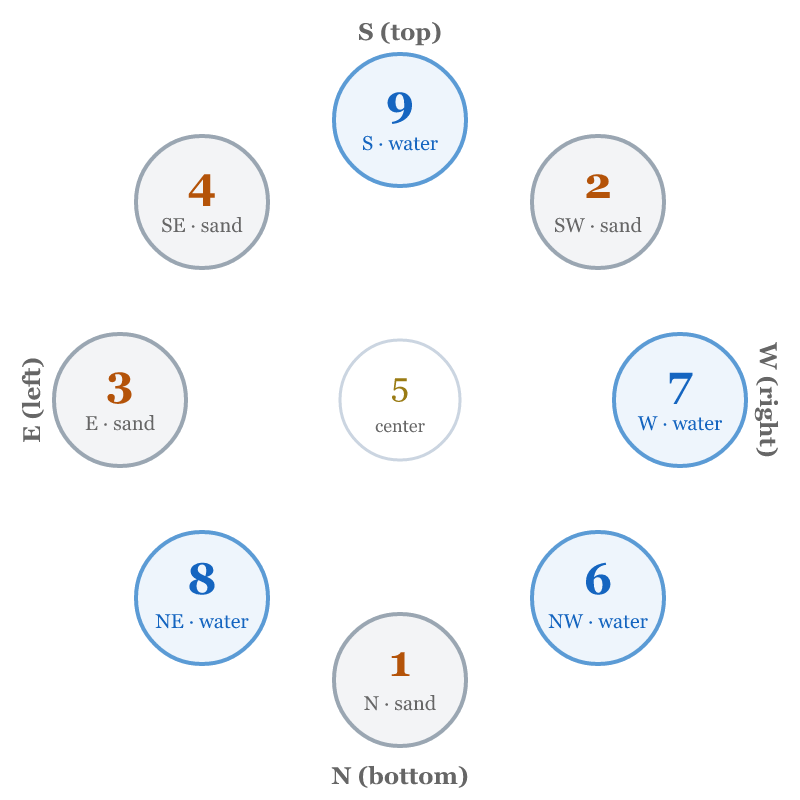
The iron rule: 1-2-3-4 want sand, 6-7-8-9 want water
The eight palaces around the center carry the After-Heaven Bagua numbers. The rule that drives the whole method is short enough to memorize in one breath:
One, two, three, four want sand. Six, seven, eight, nine want water. The center, five, is not read.
In compass terms that means:
| No. | Palace | Direction | Wants |
|---|---|---|---|
| 1 | Kan | North | Sand |
| 2 | Kun | Southwest | Sand |
| 3 | Zhen | East | Sand |
| 4 | Xun | Southeast | Sand |
| 6 | Qian | Northwest | Water |
| 7 | Dui | West | Water |
| 8 | Gen | Northeast | Water |
| 9 | Li | South | Water |
When a sand-wanting palace actually has raised solid ground, that is favorable. When a water-wanting palace has open low ground, that too is favorable. The reverse — water where sand is due, or sand where water is due — is where problems are read. Notice the pairs are opposites across the center: 1 with 9, 2 with 8, 3 with 7, 4 with 6. We map all eight directions in The 24 Mountains and the Bagua.
The part beginners miss: the facing-palace comparison
Here is the subtlety that separates a real reading from guesswork. Sand and water are not absolute. The same road, the same rise of ground, can be either — depending on what sits opposite it.
Nearer by an inch is sand; farther by an inch is water. Higher by an inch is sand; lower by an inch is water.
You always judge a direction against its facing palace. A road that is closer and higher than the open ground across from it reads as sand; the same road, if it is the lower and farther feature, reads as water. Skip this comparison and the entire reading becomes arbitrary — this is the single most common beginner mistake, which we revisit in Myths and Mistakes.
What counts as sand and water today
The classics were written for villages of hills and streams. The method translates cleanly to modern life once you know the equivalents.
| Sand (high · near · solid) | Water (low · far · open · moving) | |
|---|---|---|
| Outdoors | Tall buildings, walls, bridges, towers, hills, large trees, transformers, monuments | Roads, rivers, ponds, plazas, parking lots, empty lots, low ground |
| Indoors | Stove, large appliances, heavy furniture, solid partitions | Running taps, bathrooms, doors, windows, open floor space |
One practical note from the tradition: indoor objects only "count" when in use. A stove that is never lit, or a tap that is shut off, exerts little influence — the energy follows function, not just form. The full city-and-apartment workflow is in Finding Sand and Water in a Modern Apartment or City Block.
Two layers of meaning: the unborn and the living
The tradition adds one more distinction worth knowing early. The Before-Heaven arrangement is said to govern what has not yet come to be — matters of health, formation, and the body — while the After-Heaven arrangement governs what already exists — vitality, livelihood, and the course of a life. In practice this is why the same palace can speak both to a health tendency and to a life outcome. The 24 Mountains article explains how the two arrangements sit together.
Why so few variables works
Reducing a site to sand and water is not a simplification for beginners — it is the method's strength. Two clean variables, measured against a fixed rule and a facing-palace comparison, produce observations that are specific and repeatable. That discipline is also its risk: applied without care, it tempts over-confident predictions. We teach it as a framework for clear observation, not fortune-telling.