CORE METHOD
The 24 Mountains and the Before/After Heaven Bagua, Explained
Jin Suo Yu Guan reads a site by direction — and its map of directions is the 24 Mountains. This guide shows how the circle is divided, how the Before-Heaven and After-Heaven Bagua sit behind it, and how the system fixes which direction wants sand and which wants water.
Why direction is everything here
In Sand and Water we saw the iron rule: some palaces want sand, others want water. But "want" implies a fixed map — a way of saying exactly which slice of the compass we are reading. That map is the 24 Mountains, and underneath it are the two arrangements of the eight trigrams.
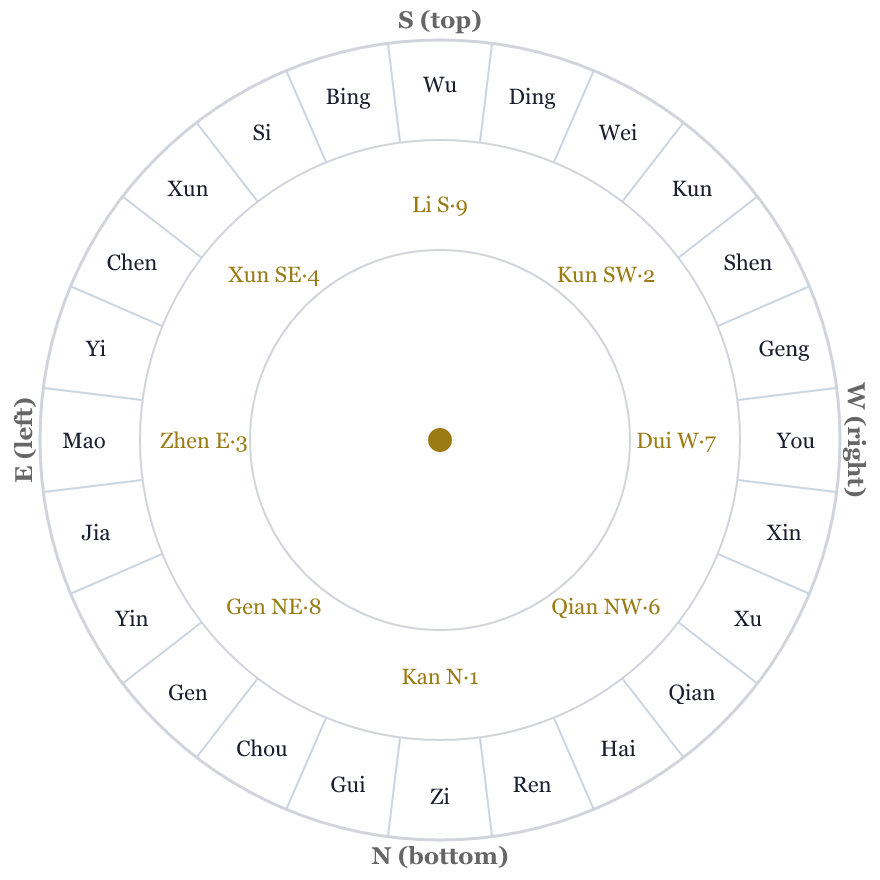
From 8 palaces to 24 mountains
The full 360° circle is divided into eight palaces of 45° each. Each palace is then split into three "mountains" of 15°, giving 24 Mountains in total. The naming follows a consistent pattern:
- The four cardinal palaces (N, E, S, W) take an Earthly Branch in the middle, flanked by two Heavenly Stems — e.g. North is Ren · Zi · Gui (壬子癸).
- The four corner palaces (NE, SE, SW, NW) take the trigram name in the middle, flanked by a Branch and a Stem — e.g. Northwest is Xu · Qian · Hai (戌乾亥).
- The central stems Wu and Ji (戊己) stay at the center and are never assigned to a direction.
| Palace | Direction | Three Mountains | After-Heaven No. | Wants |
|---|---|---|---|---|
| Kan | North | Ren · Zi · Gui (壬子癸) | 1 | Sand |
| Kun | Southwest | Wei · Kun · Shen (未坤申) | 2 | Sand |
| Zhen | East | Jia · Mao · Yi (甲卯乙) | 3 | Sand |
| Xun | Southeast | Chen · Xun · Si (辰巽巳) | 4 | Sand |
| Qian | Northwest | Xu · Qian · Hai (戌乾亥) | 6 | Water |
| Dui | West | Geng · You · Xin (庚酉辛) | 7 | Water |
| Gen | Northeast | Chou · Gen · Yin (丑艮寅) | 8 | Water |
| Li | South | Bing · Wu · Ding (丙午丁) | 9 | Water |
A practical note: although each palace is named with stems and branches, readings are taken from the branches (the directional slices), not the stems. The stems mainly label the edges of each 15° mountain.
The two Bagua: why there are two arrangements
Behind the 24 Mountains stand two classic arrangements of the eight trigrams. Understanding the division of labor between them is what makes the readings coherent.
Before-Heaven Bagua (Fu Xi)
The "before-heaven" arrangement pairs opposites across the center (Heaven–Earth, Fire–Water). In Jin Suo Yu Guan it is taken to govern what has not yet come into being — formation, the body, health and constitution. Its numbering is Qian 1, Dui 2, Li 3, Zhen 4, Xun 5, Kan 6, Gen 7, Kun 8.
After-Heaven Bagua (King Wen)
The "after-heaven" arrangement describes the world in motion through the seasons. It governs what already exists — vitality, livelihood, and the unfolding of a life. Its numbering — Kan 1, Kun 2, Zhen 3, Xun 4, Qian 6, Dui 7, Gen 8, Li 9 — is exactly the one used in the iron rule.
The shorthand the tradition uses is: Before-Heaven governs the body and what is unborn; After-Heaven governs the living and their fortunes. This is why a single direction can speak both to a health tendency and to a life outcome — you are reading it through both lenses at once. (For the foundations of each arrangement on their own, see the Before-Heaven and After-Heaven Bagua articles.)
The family map: who each palace represents
Each palace also stands for a family member, which is how a reading becomes specific about whom it concerns.
| Palace | Family role | Element / nature |
|---|---|---|
| Qian (NW) | Father / elder male | Yang Metal · longevity, status |
| Kun (SW) | Mother / elder female | Yin Earth · support, land |
| Zhen (E) | Eldest son | Yang Wood · honor, vigor |
| Xun (SE) | Eldest daughter | Yin Wood · scholarship |
| Kan (N) | Middle son | Yang Water · effort, wisdom |
| Li (S) | Middle daughter | Yin Fire · wealth, brightness |
| Gen (NE) | Youngest son | Yang Earth · children, wealth |
| Dui (W) | Youngest daughter | Yin Metal · speech, windfall |
Put the three layers together — direction, sand/water preference, and family role — and you can already form a basic reading. The detailed meanings live in Reading Sand and Reading Water, and we translate them into life areas in Wealth, Health, and Family.
How to use this map in practice
- Stand at the center point of the home or room.
- Use a compass to find the eight directions, then the 24 mountains within them.
- For each palace, note whether reality offers sand or water — judged by the facing-palace comparison.
- Check it against the iron rule, then read the family role and life area it points to.
The step-by-step version for real homes is in Finding Sand and Water in a Modern Apartment or City Block.