CORE METHOD
What Is Jin Suo Yu Guan (Golden Lock and Jade Pass)? A Complete Guide
Jin Suo Yu Guan — the "Golden Lock and Jade Pass" — is a school of Chinese feng shui famous for reading a place with only two variables: sand and water. This guide explains what it is, where it sits among the major feng shui traditions, and how its method actually works.
A one-sentence definition
Jin Suo Yu Guan (金锁玉关), literally the Golden Lock and Jade Pass, is a compass-based school of Chinese feng shui that judges a site by examining only two things in each of twenty-four fixed directions: where the land is raised and solid (called sand) and where it is low, open, or moving (called water). Each direction has a built-in preference for one or the other, and the reading follows from whether reality matches that preference.
It is also widely known as Guo Lu Yin Yang (过路阴阳), the "Passing-by Yin-Yang," because an experienced reader can walk past a building, glance at the surrounding forms, and reach a judgment quickly — without the multi-layer chart work that other schools require.
Where it comes from
Like many Chinese metaphysical arts, Jin Suo Yu Guan carries several origin stories that are traditionally attributed to ancient figures. These are best treated as cultural lineage narratives rather than documented history. What is verifiable is that the system was organized and taught openly in mainland China across the late twentieth century, and that distinct family and teaching lineages preserve their own wording and emphasis.
The lineage taught here descends through the Zhang family: Zhang Shuhuai → Zhang Yazhong → Zhang Zhiye. Because the precise verses and case interpretations vary by lineage, this site presents the method as transmitted within that family line, rather than as a single universal text.
The core idea: sand and water
Most feng shui schools track many factors — flying stars, trigram pairings, birth-year compatibility, time cycles. Jin Suo Yu Guan deliberately strips the picture down to two:
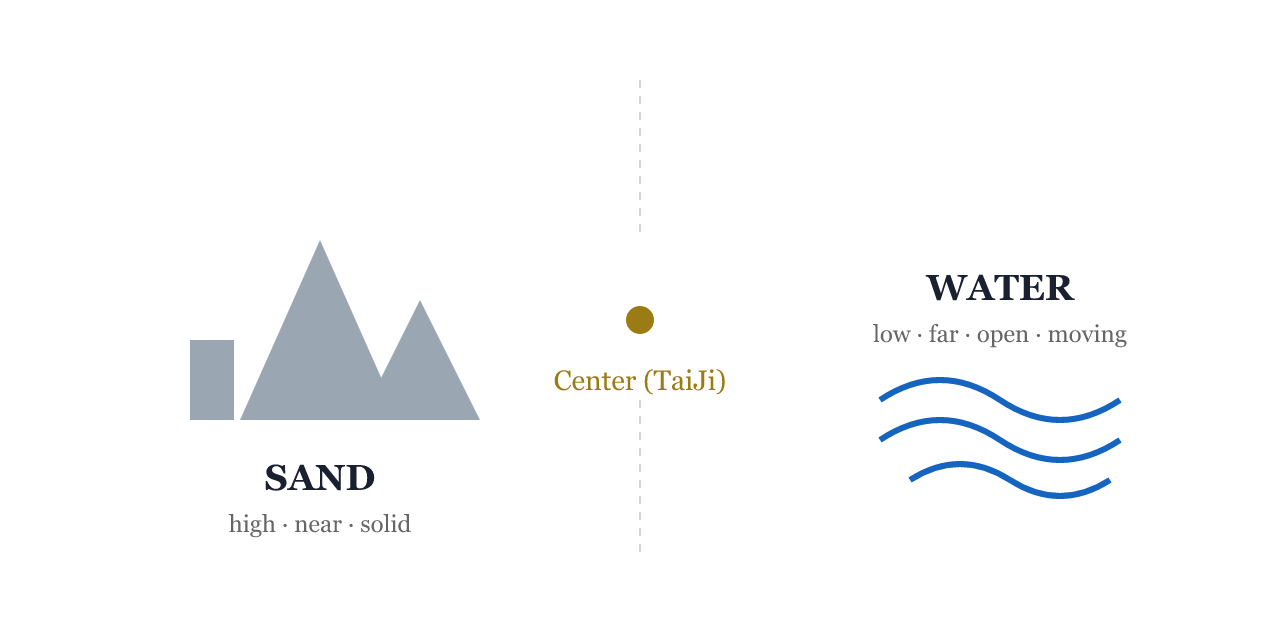
- Sand — anything high, near, and solid: hills, walls, tall buildings, bridges, towers, large trees, even furniture and appliances indoors. In traditional terms, sand "governs people" — health, character, and standing.
- Water — anything low, far, open, or moving: rivers, ponds, roads, plazas, empty lots, low ground. Water "governs wealth" — flow, opportunity, and resources.
The genius of the system is the one iron rule that tells you which is wanted where. Using the After-Heaven numbers of the eight palaces, the rule is: positions one through four want sand; positions six through nine want water (the center, five, is not read). Get the right element in the right place and the reading is favorable; get the opposite and it is not. We cover this in depth in Sand and Water: The Two Variables Behind Every Reading.
"Where sand is due, have sand; where water is due, have water." — a traditional summary of the method (wording varies by lineage).
How a reading is built, step by step
- Find the center. Every reading starts from a fixed center point (the TaiJi point) — the middle of the home, room, or grave site.
- Set the directions. The full circle is divided into the 24 Mountains — eight palaces of three "mountains" each, fifteen degrees per mountain.
- Survey sand and water. In each direction, note what is raised and solid versus low and open, judged by the facing-palace comparison — nearer or higher counts as sand, farther or lower counts as water.
- Compare to the rule. Does each palace have the element it wants? Reading Sand and Reading Water explain what each palace signifies.
- Translate into meaning. Each palace maps to family members, body parts, and life areas — see Wealth, Health, and Family.
How it differs from other schools
| Dimension | Jin Suo Yu Guan | Flying Stars (Xuan Kong) | Eight Mansions |
|---|---|---|---|
| Main input | Sand & water in 24 directions | Time-based star charts | Door/occupant trigram match |
| Time cycles | Largely not used; readings stay constant | Central — changes by period | Minor |
| Learning curve | Low to start, deep to master | High — requires chart plotting | Moderate |
| Best at | Fast, concrete reads of people & wealth | Timing of fortune by year/period | Matching a dwelling to a person |
None of these schools is "the right one." Many experienced practitioners treat Jin Suo Yu Guan as a fast, concrete layer that pairs well with the larger landscape view of Form School and the timing view of Flying Stars.
What it can and cannot tell you
Used well, the method gives clear, repeatable observations about how an environment may influence the people who live in it. Used carelessly, it tempts beginners toward fatalism and over-specific predictions. This site teaches it as an evidence-minded, educational framework — not as a guarantee of wealth, health, or any fixed destiny. For the most common pitfalls, see Seven Common Feng Shui Myths and Reading Mistakes.
Where to go next
If you are new, start with the foundations and then follow the core method:
- Foundations: TaiJi and Yin-Yang, the Five Elements, Stems and Branches, and the Bagua.
- Core method: Sand and Water → The 24 Mountains → Reading Sand → Reading Water.
- Practice: Apartments and Cities and Wealth, Health, and Family.